|
The following biography of Elder Wilson Thompson is found in History Of The Church Of God, From The Creation To A.D. 1885; by Cushing Biggs and Sylvester Hassell. Elder Wilson Thompson (1788-1866), a native of Hillsborough, Kentucky, is regarded as the ablest Primitive Baptist minister that ever lived in the United States. There was in his eventful experience a combination of some of the most striking features in the experiences of Abraham, Moses, Samuel, Isaiah, Jeremiah, Peter and Paul, demonstrating that he was exercised by the same eternal and unchangeable Spirit as were the old prophets and Apostles. The depth, solemnity and fulfillment of his spiritual impressions prove that the God of Israel still sits upon the throne of the universe, and during this century has been carrying on His work of salvation in this country of ours, not in a new manner, but in the very same essential manner that He has been employing since the establishment of His church on earth. Especially does the solemn testimony of the Apostle Paul, in acts 20:33-35; 2 Corinthians 11:26, 27 and Galatians 1:10-12, impressively reappear in Elder Thompson's Autobiography. He was of an old Baptist family, of English, Welsh, Scotch, Irish and German descent. When he was born it was thought that he and his mother would immediately die; but Elder James Lee, his father's half-brother, having been called in to pray, received strong assurance at the throne of grace that the child would be spared, and would become a minister of the gospel; and when he rose from his knees he so declared, and repeated it many times in subsequent years, always with the same assurance; but this was never told the child until after he began to preach. His parents were very poor, and could give him very little education; but God, who had given him his extraordinary faculties, was equally careful to give him exactly the right and best kind of an education for his predestined and remarkable life-work. His father was a Deacon in the Baptist Church, had a special gift in discipline, prayer and exhortation, was a fine singer, and able in the Scriptures, sound in faith, interesting in conversation, and hospitable in his manners. Elder Thompson had religious impressions from
his earliest recollection; and, during the first twelve years of his
life, without, any instruction from any person or book, he became a
thorough graduate in Arminian or Pharisaic or natural religion- While in his thirteenth year he went to see
Elder James Lee baptize some candidates, among others a small, slender
girl, named Mary Grigg, who afterwards became Elder Thompson's wife;
and, while this girl was being led into the water, suddenly all nature
seemed to him to be overspread with a dark, heavy, angry, threatening
gloom, and he felt like one forsaken of God and man, the most loathsome
and guilty wretch that lived on earth, utterly corrupt without and
within, and justly exposed to the everlasting wrath of an infinitely
holy God. He left the company and the water in despair, and sought a
deep ravine in the wood, expecting there to die alone. While there, the
darkness increased and weighed heavily upon his heart. He longed, above
all things, to be holy, and felt that, above all things, he was furthest
from it. For three days and nights he continued in such gloom that he
did not seem to have one hopeful thought of his salvation, and, while
his heart prayed all the time for mercy, if mercy were possible, he did
not dare to make a formal prayer, because feeling it impossible for a
holy God to pardon such a sinner as himself. Still he would seek the
woods, fall upon his knees, close his eyes, and make confession of his
sinfulness and of God's justice in his condemnation. While thus engaged,
on the fourth day, he was startled three times by the sudden appearance
of a glittering brightness, visible only when his eyes were closed, and
each time increasing in brilliancy, so that at last in amazement he
sprang to his feet, opened his eyes, and saw all nature glittering with
the glory of God. He was so completely captivated with the scene, and so
absorbed in the contemplation of the goodness of God, that he forgot
everything else. He walked about, gazing, wondering and adoring that
God, who seemed almost visible in the works of His power, wisdom and
goodness. The gloom and the burden of sin were gone; but he soon began
to be troubled because his trouble had left him, and he feared that his
heart had become too much hardened to feel sin, and he never once
thought of this being conversion. He attended a prayer-meeting, and,
while on his knees, there came upon him a feeling of enraptured love for
God and His people, such as he had never before realized; and when the
congregation arose to their feet and began singing, they seemed to him
transfigured with the glory of God and the beauty of holiness- On his way home he became despondent again, and sought for his burden, and repined because it was gone. But on the next day, while alone in a grove, his soul was again filled with love for Christians, and peace and comfort. He had these changes of feeling, more or less, during life. In June, 1801, he went before the church called the “Mouth of Licking,” and related the reason of his hope, and was baptized by Elder James Lee, who said, as he led him down into the water, “I am now about to baptize one who will stand in my place when my head lies beneath the clods of the valley;” many of those present knowing that he thus alluded to the convictions expressed shortly after the candidate's birth, but the latter, knowing nothing of that, only understanding him to speak of the probability of himself living after Elder Lee's decease. When raised from the water his first thought was, “O! that sinners could but see and feel the beauties of a Savior's love!” And he felt a strong desire to speak of the glorious plan of salvation, but, remaining silent in language, he burst into tears, and came out of the water weeping like a child. These impressions continued, but he strove to subdue them, feeling that he was so young and ignorant, and might bring reproach upon the sacred cause. For about nine years he resisted, and at last came to the conclusion that he would rather die than try to preach. But his impressions continued to increase, and he was suddenly attacked with a disease called “Cold Plague,” and for a time his life was despaired of, and once he was thought to be dying. He was conscious, however, and his mind was exercised about preaching, and he concluded that if he should ever get well again, and feel the same weight of soul to preach Christ and Him crucified, he would make the attempt. He recovered, but still felt that, being a poor, backwoods, ignorant boy, he had no qualification for the ministry. But he began leading in prayer and exhortation in prayer-meetings and singing schools taught by himself, and eyes unused to weep would flow with tears. He was so troubled in mind, and lost so much sleep and appetite, that his parents feared he would commit suicide, and had him sleep on a bed on the floor in the same room where they slept on a bedstead. One night after all had retired, and the fire had burned down, and all was dark save a faint gleam from the brands and coals, a shadowy form seemed to approach him, bend over him, and say, “I know your trouble, and your great desire to know what you should do; and I have come to tell you. Read the sixth and tenth chapters of Matthew Mat 6; Mat 10, and to every sentence answer, ‘I am the man,' and you will soon come to know your duty.” This was done and said three times. He believed that the appearance was not literal, but a vision (acts 2:17, 18). The next morning he slipped off with the Bible to a secret place, and did as directed, but could not be satisfied. (The sixth chapter of Matthew, it may be remarked, emphasizes the inward, spiritual, filial, heavenly character of true religion; while the tenth chapter contains Christ's commission to His Apostles to go, fearless of man and dependent upon God, and preach to the lost sheep of the house of Israel.) His mind became greatly exercised on the Scriptures. He finally told his feelings to his pastor, and the latter related them to the church, which at once gave him license to exercise his gifts in any way or at any time within the bounds of the North Bend Association. His first text, Feb., 1810, was John 10:2, 3. He now spoke once or twice a week, and the power of the Lord was gloriously manifested. Saints were revived; sinners were awakened; backsliders were reclaimed; and new converts began to sing and tell what great things the Lord had done for them. The still, deep and solemn work of God's Spirit was plainly evident to spiritual minds. In May, 1810, he was married to Mary Grigg. He became deeply impressed with a conviction that God had a work for him to do in Missouri Territory, though he had never been there, and knew very little of the country or people. In his mind he could see the people there gathering in crowds to meeting, while a wonderful change for the better was going on among them. The church gave him license to preach the gospel wherever God in His providence should direct. He was very poor indeed. In a journey of great hardship, he removed, with his wife and his father's family, to Southern Missouri, in Jan., 1811; and located seven miles from a small and very cold Baptist Church named Bethel, there being then only one other Baptist Church in the southern part of the Territory. He and his wife and parents gave in their letters, and joined Bethel Church. He had to labor hard for the support of his family, by teaching and farming, and he endured sore privations and persecutions. The people of that section were exceeding ungodly, intemperate and immoral. He preached in that and other neighborhoods. In December of the same year a very favorable pecuniary proposition was made to him to move elsewhere; but the Lord interfered and deeply impressed him with the fact that He would soon begin a great work of grace in that section. He communicated these impressions to his wife and parents. He bought fifty acres of land in the green woods, a mile and a half from Bethel meeting-house, and moved into a little cabin there with his family. A few days afterwards there were several earthquake eruptions, making deep chasms in many parts of Southern Missouri; and for three days and nights the sun, moon and stars were concealed by a heavy fog while ever and anon a hard shock would seem to threaten the world with destruction. He himself felt perfectly calm, and pursued his daily business, and, by request, began holding evening meetings. Soon an unusual effect was visible. The old brethren were revived, and engaged in prayer and short exhortations. At the regular church meeting, instead of the usual number of about twenty persons, the house was crowded on Saturday. In the conference eleven persons came forward and gave clear and satisfactory evidence of their hope. The next day the people came from twenty and thirty miles around; and the number was so great that preaching had to take place out of doors. The text used by Elder Thompson was Rom 6:23. Solemnity, deep as death, was depicted on most of the countenances of the congregation. After the sermon, some twenty or more arose simultaneously and came forward, and requested him to pray for them, poor, undone sinners. He stood dumb for a moment, and on this and similar occasions, made remarks about as follows: “My dear friends,
you request me to pray for you as helpless sinners. I am as poor and
helpless a sinner as any of you. I can only pray for myself or for you,
when I have the spirit of supplication granted me. I can do you no good;
you must not think that my prayers can save you, or move the compassion
of God. I am as poor and unworthy as any of you; but I do know that
there is forgiveness with God. While I am authorized to preach both
repentance and remission of sins in the name of Jesus Christ, I feel
willing to ask of God, in the same name, for the manifestation of that
forgiveness to all of us, and in accordance to His will- The evening meetings continued; there were no mourning benches, but many mourning hearts, hiding from the public gaze in some dark corner, secretly imploring God for His mercy. In January, 1812, Elder Thompson was ordained
by Elders Stephen Stilley and John Tanner; the latter- Elder Thompson's library consisted of a small
Bible, Rippon's Hymn Book, and Bunyan's Pilgrim's Progress; and his
study was either on his little cabin hearth, with a light made from
bark, or in his clearing, while his brushfires were throwing a brilliant
light around him; and at the midnight hour the sound of his axe echoed
through the solitary forest, and he meditated upon the deep things of
God revealed in the Scriptures, and in the earth around him, and in the
spangled firmament above. The good work of God continued in that
section eighteen months, and Elder T. baptized there some four or five
hundred persons all professing
to be sinners, and to trust in Christ alone as their Savior; by the
almighty power of Divine grace the barren wilderness had been made to
blossom as the rose. And yet, soon after this time, he became as
despondent as Elijah fleeing from Jezebel after the display of God's
glory on Carmel. He felt himself to be a poor, useless rod, that had
been used by the Father for the good of His children, but was not itself
a child, and was now to be cast away. He resolved never to preach again;
but God comforted him and encouraged him to go on. He remained there
another year, working hard for the support of his family, preaching in
four different places and traveling two hundred and forty miles a month,
a good deal on foot, and receiving no aid from those whom he served in
the gospel- He was requested by Elder Isaac McCoy to join him in his Mission to the Indians, and he was at first disposed to do so; but, upon a thorough examination of the New Testament, he became entirely satisfied that the modern missionary system was, in all respects, directly contrary to God's plan and to apostolic practice; and this persuasion increased the longer he lived. He moved to Lebanon, Ohio, on a call from the church at that place, and while living there he published two books, “Simple Truth” and “Triumph of Truth,” opposing Fullerism, and thus brought upon himself much persecution. Considering “person” to mean a distinct and separate individual, he objected to the saying that there were three persons in the Godhead; though he maintained the unity of God, and, at the same time, the divinity of the Father, Son and Spirit. Challenged to discuss religious questions publicly with the champions of other denominations, he displayed transcendent powers of debate. Going to Cincinnati to observe for himself a wonderful modern “revival,” he could see no evidence of any genuine work of grace. In 1834 he moved to Fayette County, Indiana, having received special direction to leave Lebanon; and he became the pastor of three churches in the Whitewater Association. There were not many additions to the churches, until in 1843 there were 247 that joined the churches in that Association. While residing in Indiana he made extensive tours of preaching in New York, New Jersey, Delaware, Pennsylvania, Ohio, Kentucky, Virginia, North Carolina and Georgia; and his ministerial gifts and Christian virtues shone with starry brilliancy, and numerous sinners were moved, and multitudes of saints were comforted and established in their most holy faith, remembering and mentioning with delight, as long as they lived, those wondrous ministrations of the divinely called and divinely qualified servant of God. In regard to the use and effect of the preached gospel, Elder Thompson held, with the majority of Old School Baptists, that it is not the means of imparting spiritual life to the dead sinner; that as no means can be used to give life to one literally dead, even so no means can be used to give eternal life to those who are dead in sins; that, as all temporal means are used to feed, nourish and strengthen living subjects, and not dead ones, so the preaching of the gospel is the medium through which God is pleased to instruct, feed and comfort His renewed children, and not by which He gives life to the dead sinner whom the Spirit alone can quicken; that the gospel is the proclamation of good tidings of great joy to those who have a hearing ear and an understanding heart to receive it, and to these it is the power of God unto salvation, saving them from the false doctrines of men, and feeding and making them strong in the truth. He deeply regretted that brethren in heart should suffer themselves to be divided on this subject by partisanship and ambition; and he lamented the coldness resulting from such divisions, and earnestly labored to heal the breach thus caused, though he would not compromise the truth. In a sermon preached in 1859 on 1Cor 15:54, he, among other things, said: “The doctrine of the
resurrection of the dead, as shown by Paul in this chapter, is
emphatically a cardinal point in that heavenly message of glad tidings
sent to earth, called the gospel of our salvation. If the dead rise not,
then Christ is not risen, and we shall not rise, and our faith is vain,
and we are yet in our sins. But if Christ be risen from the dead as the
first fruits of them that slept, then all His saints, as the entire crop
or harvest, shall finally rise in His likeness. Paul says that the
Apostles, including himself, and more than five hundred brethren, the
most of whom were living when he wrote, were personal witnesses of the
resurrection of Christ; and that, as Adam represented the whole crop of
his posterity, and they all died in him, so Christ represents the whole
crop of His spiritual seed, and they shall all be made alive in Him, and
in His heavenly and perfect likeness. Some modern Sadducees profess to
believe in a resurrection, but not of this identical body. They say that
when the body dies, the never-dying spirit is separated from this dying
body- Elder Thompson's last sermon was preached before the Antioch Church, in Wabash County, Ind., the third Sunday in April, 1866, from 1John 5:1,2. He spoke, with his accustomed energy, nearly an hour and a half. He gently fell asleep in Jesus on the evening of the first of May, testifying in his last moments, “I have preached that which I believed to be the truth, and in prospect of death it is my only hope. For many years I have not known the fear of death, but have been waiting till my change should come, leaving the event entirely in the hands of a just God. How great a blessing it is to have a merciful and faithful God to trust in when I come to die ! My God is a God of purpose and power; He doeth all things right.”
|
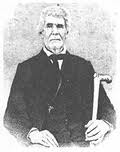 Biography
of Elder Wilson Thompson
Biography
of Elder Wilson Thompson